
how to price your artwork
With confidence
By Julie deBoer
Step by Step Guide to Pricing Your Art With Integrity, Courage, and Clarity
Let’s talk about one of the most uncomfortable topics for artists: pricing your artwork. If your stomach flips when someone asks, “How much is this piece?”, you are far from alone.
Pricing is one of the biggest hurdles artists face, and it can feel emotional, intimidating, and confusing – especially if you’re new to selling your work.
Here’s the truth you need to hear right away: your art has real value. Meaningful, emotional, transformative value. What you create helps people feel, reflect, and connect. That ability is rare, important, and worthy of fair pricing.
You may not create art for money, but money sustains your ability to create. You need supplies, space, and time. Honoring your skill through thoughtful pricing isn’t selling out—it’s showing respect for your craft, your training, and the energy you put into every piece.
This guide will walk you through how to price your artwork with confidence using transparent, market-aware strategies—so you can stop guessing and start charging what your work is truly worth.
Why Pricing Artwork Feels So Hard
Pricing is not simply math—it’s a mindset shift.
It requires:
- Confidence in your ability
- Clarity in your value
- Courage to stand behind your prices
- Willingness to let go of fear and self-doubt
You’ve been given a creative gift. Pricing is part of stewarding that gift responsibly.
How to Price Your Artwork: A Clear, Practical Starting Point
If you’ve never sold your work before, pricing can feel like a total mystery. But it doesn’t need to be. Here are the first steps every artist should take to build a pricing structure that feels grounded and fair.
Step 1: Start With Comparables
Look at what similar artists are charging.
One of the easiest ways to begin pricing your art is by examining the market. Look at artists who create work similar to yours in:
- Subject
- Style
- Medium
- Size
- Experience level
You can find pricing information on:
- Artist websites
- Online portfolios
- Social media
- Gallery listings
- Art fairs and shows
Location also matters. For example, artwork prices in the U.S. are often significantly higher than in Canada. That doesn’t mean your work is worth less—it simply means you must consider market context while building your pricing model.
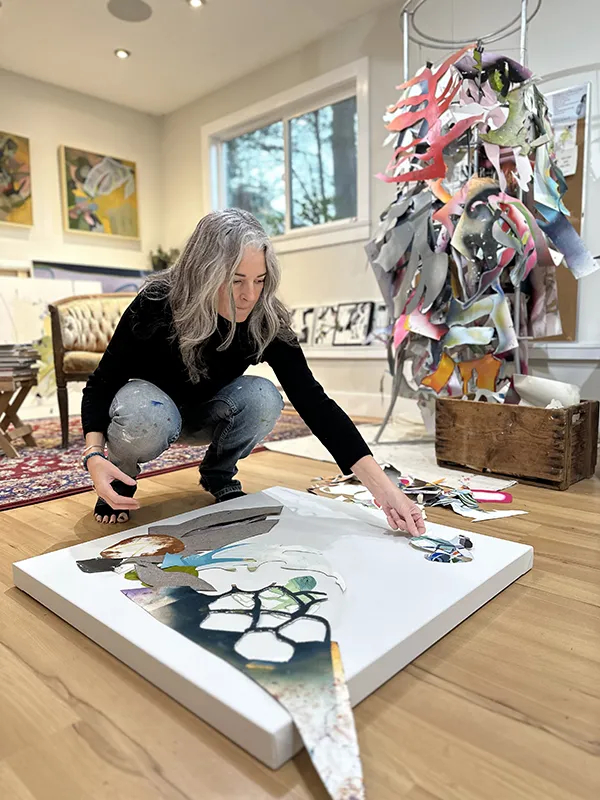
Above: Marlene Lowden in Studio, Mastrius Master Artist and Mentor
Step 2: Choose a Pricing Model
There’s no single “correct” way to price artwork. The best method is the one that aligns with your goals, your effort, and your market. Here are two common approaches.
Option 1: Price Per Square Inch
A simple, consistent method. This method uses a fixed dollar amount multiplied by the square inches of the artwork.
Formula:
length × width × price-per-square-inch
Example:
- At $3 per sq/in, a 10×10” painting (100 sq/in) = $300
- A 40×40” piece (1600 sq/in) = $4,800
Pros:
- Easy to calculate
- Extremely consistent
Cons:
- Small works can be underpriced
- Large works can end up overpriced
- Doesn’t account for time differences between sizes
Many artists eventually move away from this method as they refine their pricing.
Option 2: Sliding Scale Pricing
Fair, flexible, and market-aligned
This method adjusts the multiplier depending on the artwork size. Small pieces often require more time per square inch, so they’re priced higher per square inch. Larger pieces get a lower multiplier to remain market competitive.
Formula:
length × width × size-based multiplier
Categories may include:
- Small
- Medium
- Large
(You define the measurements for each category.)
Why artists love it:
- More accurate reflection of time and effort
- Aligns better with buyer expectations
- Helps maintain sustainable pricing over time
If you’re unsure where to start, reverse engineer comparable artists’ pricing to identify their multipliers.
Step 3: Be Consistent
Consistency builds trust with buyers.
No matter where someone discovers your work—gallery, website, Instagram, or a local show—your prices should match. Consistent pricing tells buyers:
- You know your worth
- You’ve done your homework
- You’re reliable and trustworthy
The only time to diverge from your standard pricing is during designated promotional events (ex: Square Foot Show, holiday sales, seasonal collections). Make sure buyers know it’s a limited-time offer.
Step 4: Raise Prices as You Grow
Your career will evolve—and your prices should too.
Consider raising your prices when:
- You begin showing in galleries
- You receive awards or recognition
- You sell out a collection
- Demand increases for your work
A common rule of thumb is raising prices 5% per year, or more if the market supports it. Growth should be acknowledged and reflected in your pricing.
If someone asks for a discount?
Try this simple, powerful line:
“I don’t give discounts on my work. But I do increase my prices every year.”
Then pause. Let the silence work for you.
Step 5: Protect Your Pricing
It can take years to get your pricing right—and moments to undermine it.
Be thoughtful, be consistent, and be confident.
Your time is precious. Your art is meaningful. You deserve to be paid fairly for both.
Set goals around your pricing, share them with others, and get accountability as you build a sustainable approach to selling your work.
That’s what we’re here for. This is a long, winding journey—but you don’t have to navigate it alone.

Above: Jordan K. Walker, Mastrius Mentor
I hope this practical information helps you find a price point that works for you as you grow as an artist.
Remember, it’s easier to raise your prices then lower them! But don’t sell you work short, it has value, as does your time, your passion, and your talent.
With you,
Julie deBoer
Artist & Founder
7 Comments
Submit a Comment
How To create better art, faster, and with more joy…
Join a highly vetted Master Artist in Small Group Mentorship
Our Masters can see what you can’t yet. Get personalized feedback and critiques.
Choose from 180+ professional artist mentors excited to help you get to where you want to be.
Connect with like-minded artists in a non-competitive space.
Regular sessions and accountability keep you on track.
Save on art supplies, courses, and access live weekly events hosted by our Masters.
Join 100% RISK-FREE and cancel anytime.
Groups fill fast with LIMITED SPOTS. Don’t wait to find your Master Artist mentor.
Click below for full details and to view our roster of successful mentors making a living from their art.
Do you include frame with above calculations? Or is it extra?
Hi Linda, the frame is extra.
Thanks for the two recommendations. I have followed these steps along the way an am now using a sliding scale. It has taken me a long time to get to a comfortable pricing method so I appreciate your guidance that it can take a long time..
You’re so welcome Mary!
This was a very helpful read, but how do I know (if priced by the square Inch, or, the sliding scale) what to start with… $2.00, 2.50, 3.00? Does this decision also have to do with the area one is selling in? I live in the gorgeous, high-end beach town of Naples, FL. We’re “in season” now, but who knows what an audience would be willing to pay…
I am at an intermediate level, with no recognition, awards or even a web site. My style is semi abstract, with lots of bold color. It is visually desirable to the eye, but I have never sold a painting, however, I haven’t pushed to get my work out there because I’m too busy painting. I don’t want to have to set up a tent at art fairs and sit waiting all day for a buyer. My studio walls are full of my paintings, so, I DO need to do something, soon!
Hi Carol, the best thing to do is research what other artists in your area who are at a similar skill level are doing. It takes a bit of time but well worth it. Look for artists working in the same medium and subject as well. You want your prices to land somewhere in the middle of your artist-peers.
A really good blog and me back again.