
EVENTS BASE MEMBERSHIP 30-DAY FREE TRIAL
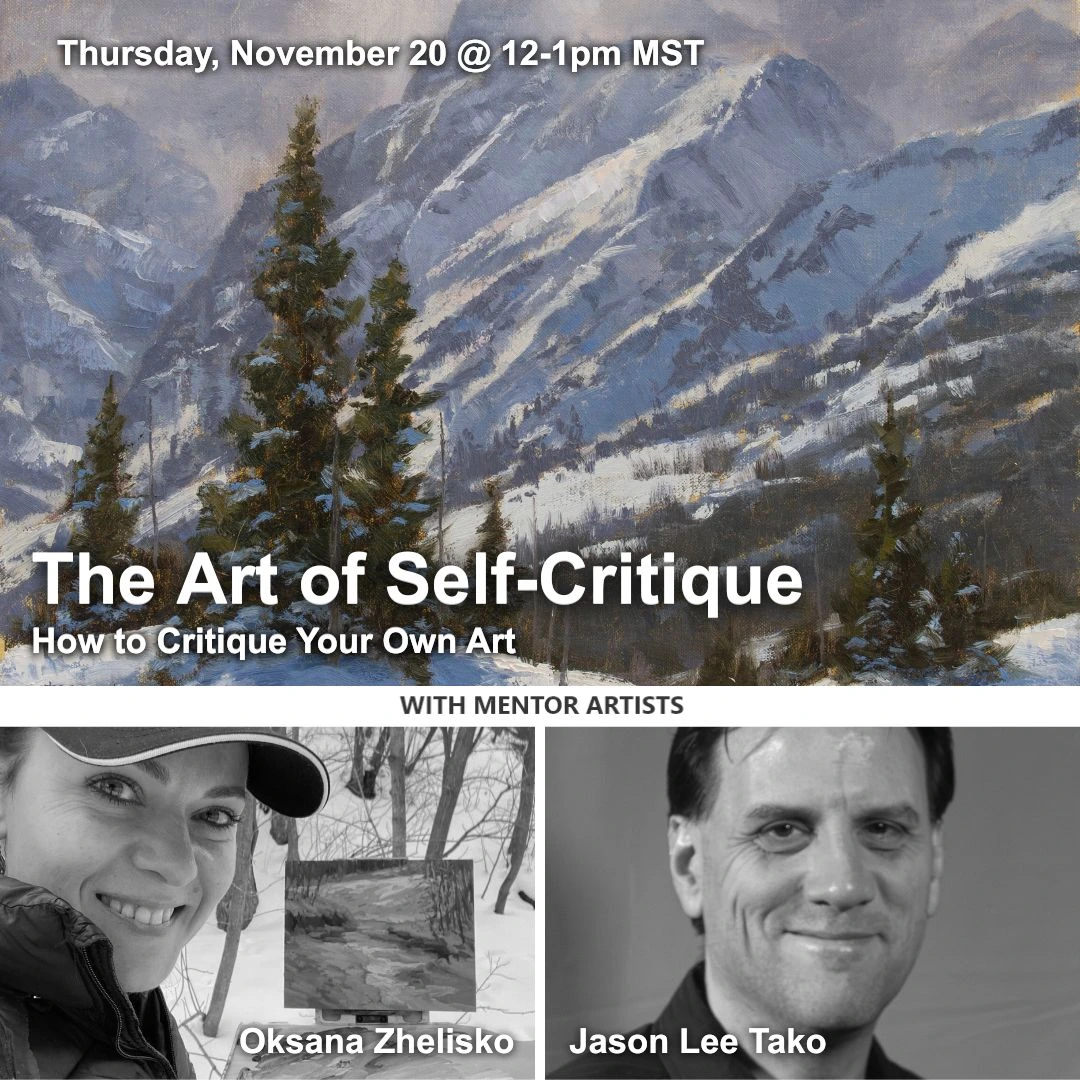
Live Panel: The Art of Self-Critique
Thursday, November 20th
12–1pm MST
2–3pm EST
7pm–8pm GMT
6am–7am AEDT (Friday)
Mentors: Oksana Zhelisko and Jason Lee Tako
$19.00
Out of stock
Free For Mastrius Members.
How to Critique Your Own Art
Learning how to critically examine your own art is the gift that keeps on giving. It’s empowering and will help you to create art that is always improving in quality. It’s a skill that every artist can develop and no… you don’t need to be a master to do it.
Receiving critiques from a highly-skilled artist is one of the best ways to grow your own skills quickly. So why not learn how to do it yourself, as you grow?
Join Mastrius Mentors Jason Lee Tako & Oksana Zhelisko as they guide you through the what, why, and how of evaluating your own work objectively and with a keen eye so you can critique your work with confidence.
You'll learn:
- What self-critiquing means and how you can begin developing the skill today
- Tips to quickly identify unbalanced compositions and common mistakes
- How to incorporate self-critique strategies into your own process, so it becomes second-nature
- How to differentiate between technical execution & artistic intent, and evaluate both
Self critique is not about being critical, it’s about being objectively constructive and engaging with your art in a new way that empowers you to grow.
Come learn from the masters and get your questions answered, LIVE!
🎟 Tickets ONLY $19 | FREE for Mastrius Members
🎙️ Event recording is available for Mastrius Members only.
👉 Get a FREE MEMBERSHIP HERE with the Base Membership Free Trial
Meet Oksana Zhelisko
Acrylic | Charcoal | Drawing | Graphite | Mixed Media | Oil | Watercolor
I prefer working in Alla-prima style (wet-on-wet) of painting and I use this style as much as possible. Even when I work on bigger paintings, I make sure to block in tonal and colour balances in my first session.
I work intuitively, bold and free from the start at the same time staying true to the emotional response of the initial idea. As I continue working on a painting, I slow down and add more calculated decisions and get certain areas tighter and more detailed.
I love this subtle connection between harsh defined edges and loose, faint lines. The marriage between transparent, flowy paint and thick, opaque layers. I love asymmetry and well-planned randomness, where your subject is only suggestive. I feel that it leaves more room for the viewer to spark their imagination.
I would like to think of myself as a storyteller. Each painting, either it is an urban landscape or figurative art, is a moment in time with deep emotions, atmosphere and purpose. If my art can touch once soul and evoke their deepest emotions – then I have succeeded as an artist.
Meet Jason Lee Tako
Charcoal | Drawing | Graphite | Oil | Watercolor
Jason Lee Tako paints the American West as a place of living memory. His pictures don’t explain so much as invite—scenes held at the hush between day and night, where dust hangs in the air and a single gesture can hold an entire story.
Rather than stage pageantry, he seeks the felt truth of a moment: the angle of the light, the tilt of a rider’s head, the way distance turns to silence. Focused on 19th-century Plains life—often Crow, Lakota, and Hidatsa—Tako researches deeply, studies period accounts, and collaborates with Native models on location near places like the Little Bighorn Battlefield. The result isn’t reenactment; it’s a door.
Tako has shown in Great Falls, Montana alongside the C.M. Russell Museum’s signature events, including the C.M. Russell Auction and the Out West Show, and in 2025 presented “A Western Story” at The Capitol Gallery in Bismarck, North Dakota. He is also the founder of Oil Painting+, where he teaches observation, composition, and the language of light to a national community. Collectors are drawn to the quiet authority of his work—art that transports without noise, carries a sense of storied time, and lives comfortably in refined rooms. These are paintings meant for unhurried evenings and the long gaze—pieces whose mystery continues to unfold.