
You start a painting full of energy but an hour later you’re hunched over a tiny brush, fixing the same petal for the fifth time, and somehow the life has drained out of the piece.
I know this feeling well. For years I painted in a distinct, tight, stylized way, until I felt bored and creatively stuck. Loosening up has been my own journey toward semi-abstract work, and I’m still on it.
This article grew out of a recent Mastrius community meetup on how to loosen up your style. A warm thank-you to our mentors Pat Fiorello, Manon Sander, Jordan Miller, Deanne Kroll, James Meyer, Alicia Farris, and others for sharing so generously, and to every artist who added ideas in the chat.
Here’s the principle I come back to again and again:
Loose, expressive paintings grow from clear intention and a playful mind.
What does it really mean to loosen up in painting?
Loose doesn’t mean chaos; you still need composition and design. Painterly artists like Richard Schmid in oils and Charles Reid in watercolor are extremely intentional. They keep crisp edges at the focal area and let the edges everywhere else go soft and suggestive.
Edges define shape, so use the full range, from hard, to soft, to lost. Looking loose isn’t about painting carelessly, it’s about choosing what matters.
When you shift from literal thinking to artistic thinking, you stop painting objects and start painting shapes of color, light and dark. There’s a lovely quote worth keeping by your easel: “A painting isn’t good because it looks like something, it’s good because it feels like something.”
Mastrius mentor Pat Fiorello shared a favorite line from Robert Henri: “Paint the flying spirit of the bird rather than its feathers.” It’s a beautiful reminder that the power of suggestion is greater than the statement of reality. To go deeper, she recommends Vlad Milan Duchev’s book The Power of Suggestion: How to Say More by Painting Less, and Henri’s classic The Art Spirit is well worth a reread.
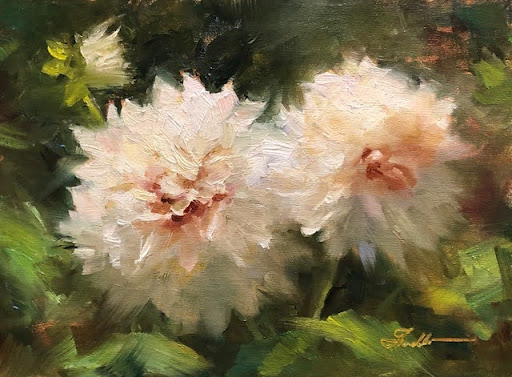
Be patient with yourself, because this doesn’t happen overnight. Often your taste shifts first, and your hands catch up with practice. The painting below shows where that practice can lead, with thick, broken strokes suggesting the blossoms and leaves melting into soft edges.
Why do artists overthink their paintings?
Most of us are result-oriented. As adults we tend to slip into production mode, especially on expensive surfaces or when a piece is headed to a show.
If good paper makes you hold back, try a stack of 100 sheets of student-grade paper. With less invested in each sheet, you’ll feel free to experiment.
How you begin matters too. If you start tight, you’ll end tighter, because the start of a painting is where intent and feeling come in, before structure. So instead of asking “Is it finished?” ask “Is it getting the point across?”
If you see yourself in this pattern, a mentor can spot exactly where your process tightens up. At Mastrius we meet and vet every mentor to ensure they are not just talented but also kind and generous.
How can you loosen up physically while you paint?
Looseness lives in your body as much as your mind:
- Stand up and paint from your shoulder. Step back often and move from your arm instead of your wrist, like your brush is a wand or sword. I paint from my shoulder too, with my left hand free for smudging.
- Choose a brush that feels too big. Hold long-handled brushes at the very end, almost like fencing. An uncomfortably large brush leaves little room for unnecessary detail, and a wide, paddle-like brush such as Liquitex Freestyle changes every stroke. Even a broken brush with a wild fiber or two can make wonderful marks.
- Be generous with paint. Use good gobs, reload every two or three strokes and leave juicy strokes alone.
- Use a tool that gives you less control. Try a palette knife, a cheap 3–4 inch hardware-store brush, a twig or your non-dominant hand. Switching tools every few minutes gives you marks you never would have planned.
Put on some music and let it be fun. To see how our mentors move and work, join Mastrius events to meet the mentors and hear and see them for yourself.
How do big shapes and values help you stop overthinking?
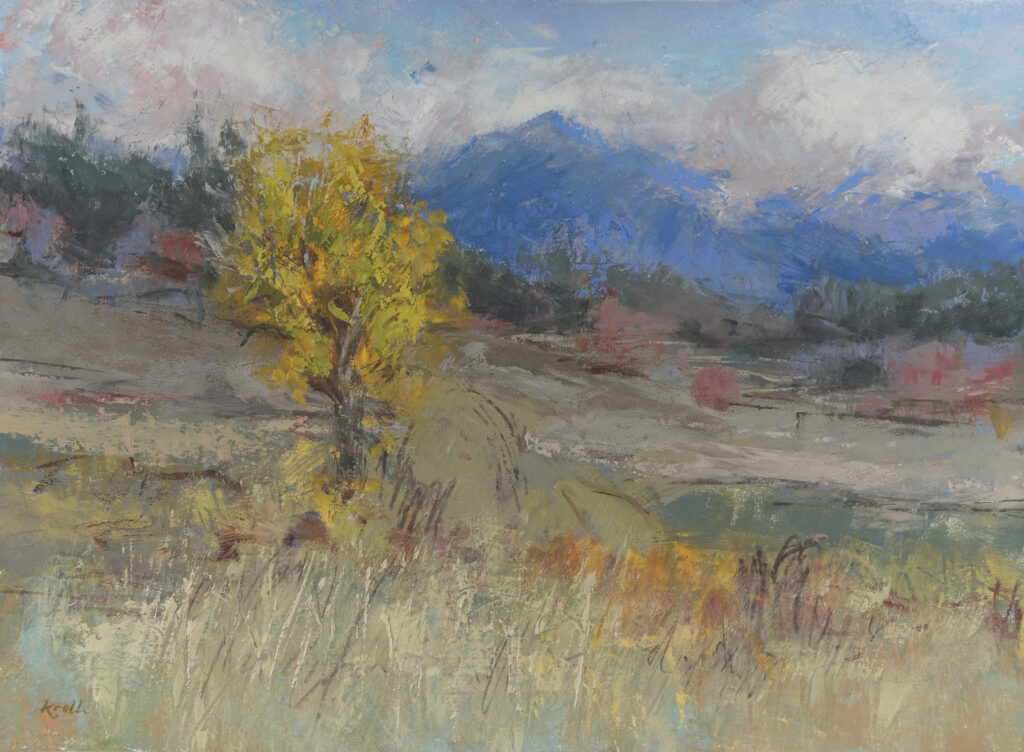
Before you pick up a big brush, make a quick notan or value study. Whittle the scene down to three or four values and five to seven big shapes, then translate those big patterns with big brushes.
When you move to the canvas, try blocking in with color, but not local color. Use intense cool colors for the shadow pattern, like rich purples, turquoises and violets, rather than browns. Your trees might become purple or blue and your sky pink, a true colorist approach.
This works beautifully on an older, detailed piece, too. Repaint it using only your notan, and practice restraint by asking how few petals or leaves you really need.
Design helps you stay big. Divide your subject into three big shapes and make nine or ten quick small studies. Pick the one that connects, try ten more the next day, then do the same with three values.
Looseness also comes with warming up, so give yourself a few starts before the one that counts. The more you paint, the looser you get.
How do you quiet the inner critic?
One of the most powerful tips came from Mastrius mentor Jordan Miller: “When the brain creeps in and I can’t shut it off, that is when I walk away.” Step back, make a cup of tea, turn the piece around and come back with fresh eyes.
Fresh eyes can surprise you. Often you’ll forget what bothered you in the first place, and sometimes you’ll paint out everything except one small passage you love, and it becomes a favorite.
Work that stays safe can become too safe, so give yourself permission to take a piece right to the edge. The canvas isn’t precious. Scribble with color to break up the intimidating white, then tighten up later and find the precious moments.
And if a mentor’s way of giving feedback doesn’t feel right for you, at Mastrius you can switch mentors anytime.
What exercises help you paint looser?
Creative constraints turn off your thinking brain and let your instincts lead. Try these:
- Set a timer. I give myself 20 minutes, tops, for an 8×8 study. When you’re tempted to keep fiddling, allow yourself just 15 more minutes or 15 more strokes.
- Limit your brushstrokes. Try a painting in 40 strokes, or a small one in just 10.
- Use one tool only. Paint the whole piece with a palette knife or a giant brush, or switch tools every time you pause.
- Flip or blur your reference. Go a step further and turn the painting itself upside down while you work.
- Start with words. Write a list about your subject, then go deeper, from nouns like trees and wind to feelings like freedom and spirit. Pick five words as your theme, and remember that every important word can become a separate painting.
- Paint from life. Still life and plein air break the autopilot habit of copying every detail.
- Play on cheap surfaces. Gesso inexpensive watercolor paper with leftover latex house paint, or grab a 3-foot roll of paper and use both hands, which I love. It moves you from production mode into play mode.
Think of it as a play date with your materials. Try not to make a painting, just make marks. Play, and you’ll find it with some time.
More ideas from the meetup chat
The chat was full of practical gems. Here are a few more to try:
- Push past your first ideas. Give yourself a prompt and make five responses. The first three are usually what you’d normally come up with, while the fourth and fifth lead to new ways of working and seeing.
- Copy a loose painting. Copying a loose painting by another artist lets you feel those bold decisions from the inside.
- Mix less. Stop mixing before a new color appears in your pile, so the original colors still sing, or mix right on the canvas.
- Look first, then build. Sit and study the light and shapes before you start, then begin with lines and keep adding loosely. On a large plein air canvas, you might even turn your back to the scene.
- Switch mediums. Markers, pastels and palette knives can help you stop trying to replicate your subject. It can feel messy, but it’s more fun and more interesting.
- Try a quality brush. For oils, a Rosemary & Co Bravura long flat, about 1.5 inches wide in size 16, is wonderful for starting paintings and bold backgrounds with broken, expressive marks. Rosemary & Co also has larger brushes that won’t break the bank, and Silver Brush Limited is another quality choice.
If you’d like guidance through exercises like these, Mastrius mentors work with artists in small groups or one-on-one, so we offer both kinds of support. You can read more about how art mentorship works at Mastrius.
Give yourself permission to play
For me, the pendulum had to swing all the way. I had to give myself permission to make a hot mess, to show myself grace and to learn to play again, the way children paint before anyone tells them how. Loosening up is a process in the moment.
If you’d like to keep this conversation going, join us at an upcoming Mastrius community meetup. You’ll find what’s coming up on our upcoming events page.
TRY THIS
- Pick one simple reference and make a quick notan with three values and no more than seven big shapes.
- Set a timer for 20 minutes and paint a small study with the biggest brush you own, from your shoulder, standing up.
- Walk away, then come back and ask: is it getting the point across, whether that’s light, movement, mood or the joy of the moment?
Looser, freer painting is closer than you think, and it starts with play.
With you,
Julie deBoer, Artist & Founder, Mastrius